
About
By 31, I'd spent over a third of my life grappling with chronic pain from not just one, but two conditions. I felt sick more days than healthy, hadn't slept properly in seven years, had lost my appetite almost entirely, and could no longer remember what it felt like to move through the day without pain.
Outwardly, I appeared to have it all — career success, financial stability, my name in the credits of six Pixar films (with my designs appearing on billboards, merchandise, and even Disneyland rides), and a growing roster of Fortune 500 clients. Yet my compounding health problems had finally become too much to manage, despite all my best efforts.
I had diligently shown up to more doctor's check-ins, physical therapy sessions, and treatment appointments than I could count. I'd taken every pill prescribed, completed every recommended exercise, and was told over and over I was one of the best patients my specialized team of practitioners had ever treated. I spent much of my free time licking my wounds, on bodywork and exam tables, or attempting to get much-needed rest.
Yet none of it was enough.
I didn't have words for it at the time, but in the pit of my stomach, I could feel that something about the care I was receiving just didn't add up.
The Limits of the Linear Model
My team of allopathic practitioners in San Francisco tended to treat things in isolation. They told me the chronic pain I had in two parts of my body was completely unrelated. That my physical health was distinct and separate from my mental and emotional well-being. Sometimes I received conflicting advice from different providers; other times their suggestions felt like the opposite of what I should be doing, but I obliged anyway, too afraid that going against the protocol might make things worse.
I cycled through physical therapy, ergonomic intervention, myofascial trigger point therapy, biofeedback, applied kinesiology, craniosacral therapy, acupuncture, acupressure, homeopathy, and osteopathy — and was given meds, patches, and injections to mask the pain temporarily, some so strong they wiped out the sensation in my problem parts and limbs, which made me wonder what kind of damage was being done during each stint of numbness. Most of my prescriptions and treatments focused solely on symptom mitigation or management, and when I asked about root causes, few on my workers' compensation team offered so much as a theory, let alone an action plan for resolving them.
The most alarming moment came when a second doctor reviewing my file noticed that two of my sleeping prescriptions — when taken together — were lethal. The same combination, I would later learn, that had killed Heath Ledger. For a chronic insomniac who often couldn't remember whether she'd taken a pill or not, this was not a theoretical risk. That a dangerous and potentially fatal combination of medications had been casually prescribed without flagging the interaction was terrifying — and it was the moment I stopped trusting that those doling out the prescriptions would do so responsibly. I weaned off the entire cocktail shortly after, exhausted by how washed out, brain-dead, and unlike myself the medications had made me feel.
Even though the intensity of my pain was sometimes dulled during the new treatment honeymoon phases, it always came back, usually with a vengeance, and each time my hope in a full recovery caved a bit further in on itself. When I was told my chronic pain was a permanent disability — unlikely ever to lift — it shrunk to the size of a grain of sand. But that small glimmer of belief — that what I'd been told was impossible was in fact still possible — thankfully never left me.
The Road Less Traveled
When years of compounding sickness, insomnia, and non-stop pain made daily life too excruciating to bear, I gave up everything and followed that stubborn little ember in search of answers abroad. That was when a much more complete picture began to emerge.
An osteopathic doctor told me there was a direct connection between my chronic pain and unresolved childhood trauma. A Balinese shaman echoed this sentiment, explaining that unhealed memories and the emotional residue they leave behind are stored as tension in the body. I discovered Dr. John E. Sarno's work on the mind-body connection. I found Gabor Maté's theories on trauma and the body's somatic wisdom, and began learning to honor its yeses and nos.
Pushing through layers of resistance and skepticism, my pain also unexpectedly led me to develop a faith that transformed me from the inside out, in ways that my white-knuckled logic and tenacious will had ultimately failed to. A lifelong agnostic, I found myself becoming something closer to a gnostic — not through doctrine or dogma, but through direct experience that left little room for doubt. An Ayurvedic doctor and a Mexican herbalist both pointed me toward the same insight: that healing required tending not just to the body or the psyche, but to something much larger.
You can do all the treatments and therapies the world has to offer, but you will never truly be well again if you don't reconnect with God, said the curandera who prescribed me six months of detoxing herbs harvested from the jungles of Mexico's Oaxaca Coast. Filled with equal parts doubt and the kind of desperation that only hitting your physiological rock bottom can provide, I honored the well-known medicine woman's instructions that evening and every day for the next six months. Three times a day, I brewed and consumed the dried herbs and tinctures exactly as she advised, and for the first time in decades, I got down on my knees and prayed to a power greater than myself each night.
The teachings of Ramana Maharshi and Ram Dass became unlikely companions on that road — one pointing inward toward the silent witness behind all thought and the direct experience of non-duality; the other reminding me that oneness consciousness and the human mess are not separate things, that the spiritual path runs straight through ordinary life rather than above or apart from it.
Several 12-step meetings, plant medicine ceremonies, spiritual mentors, and cups of potent herbal tea later, I found what I had spent a decade searching for: lasting relief from the pain I had been told I would carry for the rest of my life. After a year of dedicated healing work and open-ended world travel, my chronic pain conditions were dissolved, and a sense of genuine, integrated health would gradually take their place, just as my curandera had predicted.
A More Comprehensive Approach
When I discovered Bruce Lipton's The Biology of Belief, it gave language and structure to everything I had been piecing together. The infographic below — contrasting the linear, reductionist model of conventional medicine with the quantum, interconnected model of holistic health — crystallized something I had lived through but struggled to articulate.
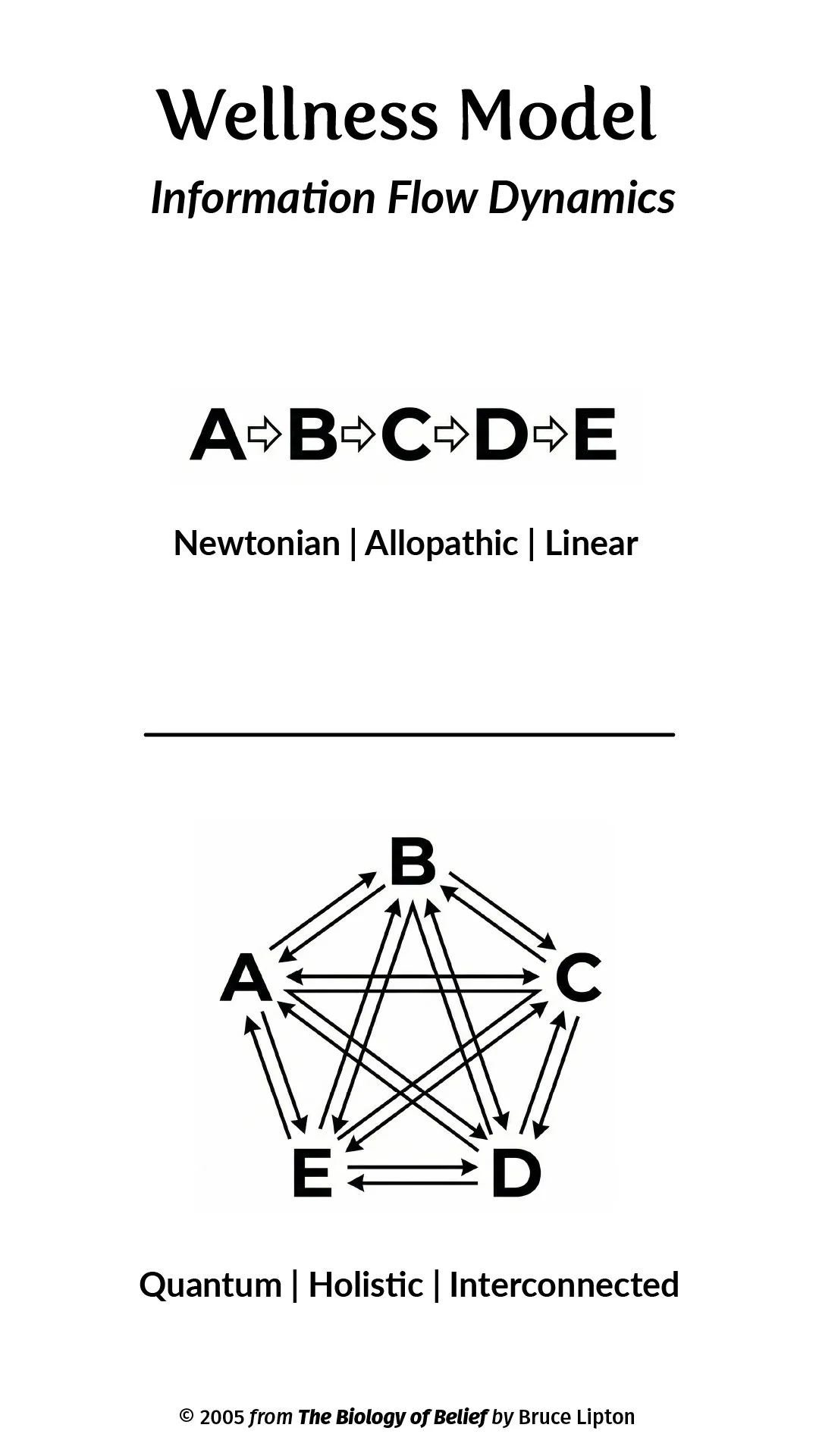
The allopathic model treats the body as a chain: A causes B, which causes C. The holistic model understands it as a web — every node in constant, multilateral communication with every other. My recovery required me to trace the strands of a complex matrix, constantly unearthing new connections and stones to unturn in the pursuit of healing.
Through painstaking and determined trial and error, I learned that true wellness is a dynamic, multifaceted undertaking. That holistic health comes most easily to those who not only recognize the body as a unified, interconnected whole, but also acknowledge the importance of tending to our psychological and metaphysical wellbeing — what ancient traditions understood as the restoration of equanimity: a state of homeostasis across all dimensions of the self; seen and unseen.
This triad — body, mind, and spirit — is not a modern invention. It is rooted in ancient wisdom traditions across cultures: in Ayurveda, the Indian science of life and longevity; in Traditional Chinese Medicine, which has long mapped the relationship between physical, emotional, and energetic health; and in the ancient Greek ideal of kalos kagathos — the unity of physical and moral excellence.
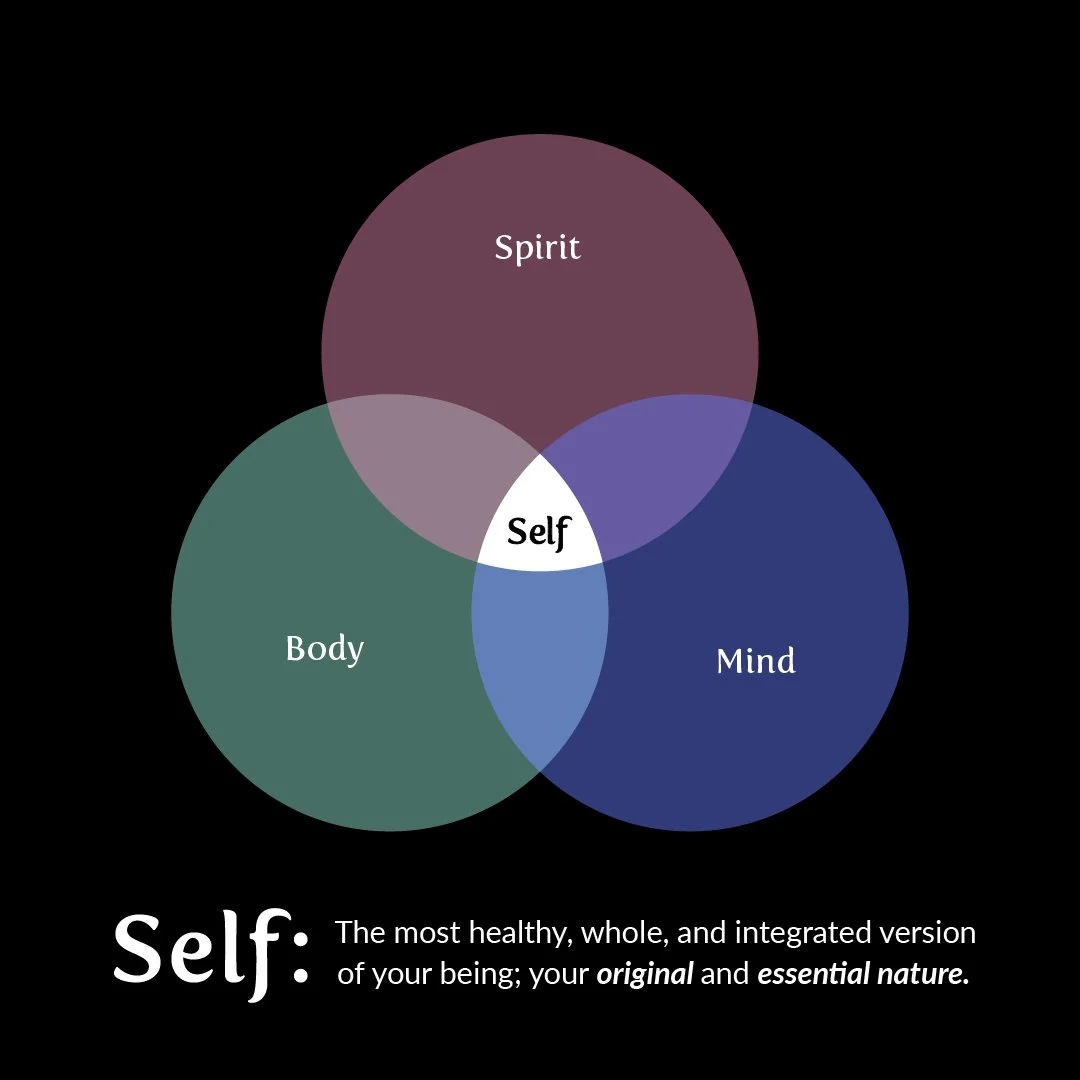
As the diagram illustrates, some practices naturally overlap or encompass all three dimensions of the self simultaneously. But by intentionally balancing all three — the gross, the subtle, and the causal — in our approach to self-actualization and wellness, we find our sovereign center.
Ayurveda gives us perhaps the most precise language for these three dimensions, through ancient Sanskrit terms whose depth and nuance are unrivaled by most modern languages:
BODY | Sharira | शरीर
The gross aspect — physical, tangible, and perishable — is our mortal vessel, acting as the seat of consciousness, the senses, and life's actions. Maintained through balanced nutrition, movement, and intentional care, Ayurvedic practice supports its natural rhythms through methods such as fasting, detoxing, and bodywork — tending to what is most visible and immediate in our experience of self.
MIND | Manas | मनस्
The subtle aspect — the internal organ of perception, cognition, and emotion. Manas bridges the senses and the intellect, processing our sensory experience, thoughts, and feelings, and is considered the sixth sense in Yogic philosophy. Clarity and emotional stability are cultivated through education, mindfulness practices, and conscious self-inquiry — allowing us to meet the world with greater presence, discernment, and perspective.
SPIRIT | Pragya | प्रज्ञा
The causal aspect — the deepest, most foundational dimension of the self. Derived from pra (superior) and jna (to know), Pragya signifies deep, intuitive, transcendental awareness of something larger than ourselves. This dimension is nurtured through yoga, breathwork, meditation, medicine work, and any pursuit that deepens our relationship with our essential nature as both divine and human being.
In a culture that defaults to superficial, stopgap solutions — that often exacerbate rather than eliminate the root causes of our pain and dis-ease — few are actually motivated, ready, or willing to dig deeper. For those who do, the road less traveled can feel treacherous, isolating, and unclearly marked. Every piece of content here — whether it focuses on the physical, the psychological, or the metaphysical — is part of the holistic map a former version of me wished she'd had.
This platform is the culmination of my lived experience and professional expertise: organizational strategy, design thinking, and systems design; the research instincts of a former journalist; the critical eye of a marketing industry insider; and firsthand product design experience that informs how I evaluate everything featured here.
My mission is to spare others the struggle, sacrifice, and trials that come hand in hand with poor health, guiding readers toward a clearer, more direct path to genuine and integrated health.
Welcome to CHANNEL ONE.